
Arrow Puzzle 3D - Arrows Out
EasybrainPuzzle
4.81.52K Reviews
- Version
- 1.6.0
- Installs
- 1.00M
- Age Rating
- Everyone
Screenshots
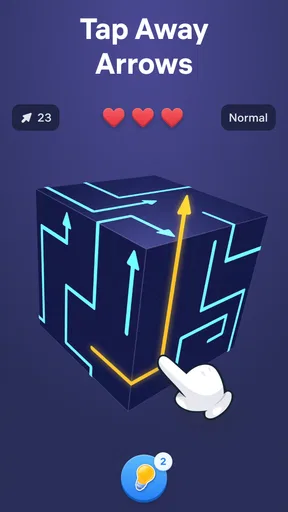
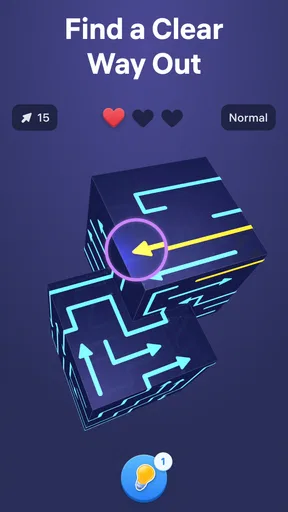
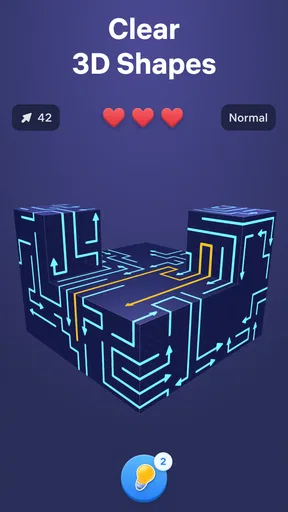
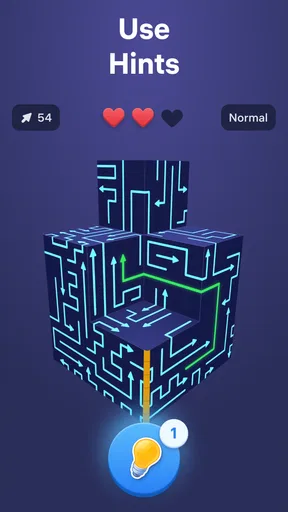
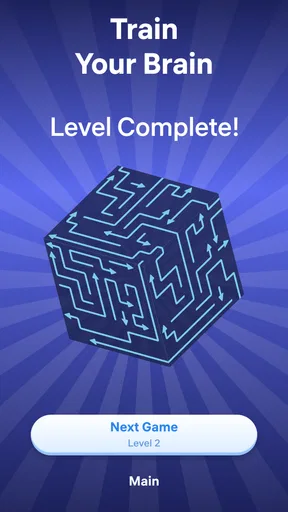
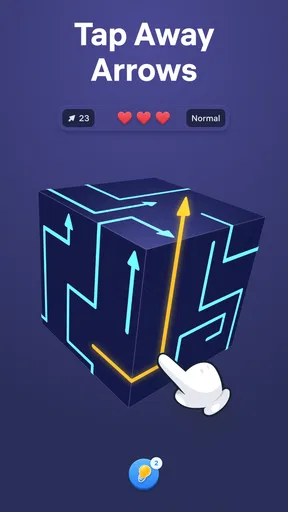
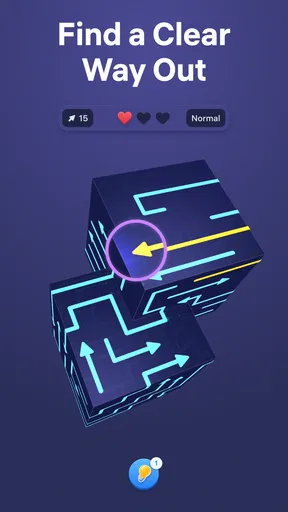
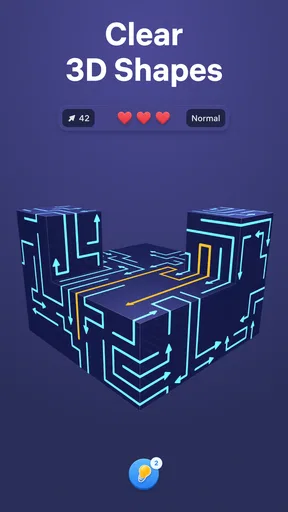
Our Review of Arrow Puzzle 3D - Arrows Out
 Analysis by Appyee
I approached Arrow Puzzle 3D - Arrows Out as a small, focused puzzle game rather than something meant to replace a larger gaming session. Its central idea is easy to understand: you tap arrows to clear them from a three-dimensional arrangement, but each move depends on whether the arrow has a clear route. That simple rule creates the real challenge. You are not merely matching colors or finding pairs; you are reading a compact structure, predicting which pieces will become available, and avoiding moves that leave the remaining puzzle awkwardly blocked.
After spending time with it, I think the game works best for people who enjoy quiet, tactile problem-solving. It is the kind of title I would open while waiting for an appointment, taking a short break, or winding down without committing to a long story or complicated control scheme. The free entry point makes it easy to try, and the Everyone rating makes its presentation approachable for a broad audience. At the same time, its appeal depends heavily on whether you enjoy spatial puzzles. If you want fast action, a deep narrative, or constant novelty, this is probably not the right fit.
How the current puzzle experience feels
The strongest part of the design is the relationship between visibility and access. An arrow may look obvious, yet still be unusable because another piece blocks its direction. That makes every board a small exercise in planning. I found myself scanning the outside edges first, then checking which removal would expose a useful lane. The best moves are often not the most visually prominent ones; they are the ones that open several future choices.
The three-dimensional presentation matters here. A flat grid can make a puzzle feel like a simple sequence of taps, while the layered arrangement asks you to interpret depth. I had to pause occasionally and distinguish between an arrow that was genuinely free and one that only appeared available from the current angle. That extra visual reading gives the game more personality than a basic matching puzzle, although it can also make a crowded arrangement feel slightly tiring on a smaller screen.
Controls are deliberately uncomplicated. Tapping is all that is needed, so the learning curve is gentle. The difficulty comes from deciding when to tap, not from mastering gestures. This is useful for short sessions because I can return after a day away without relearning a control scheme. It also means the game has to earn my attention through board design rather than through a large collection of mechanics.
One practical strength is that the game is built around offline puzzle play. I appreciate that distinction because it suits situations where I do not want to depend on a connection, such as traveling or sitting somewhere with unreliable reception. Offline access also changes how I use it: I can treat it as a dependable time-filler instead of an app that only works when the network cooperates.
That convenience should not be confused with unlimited variety. The core interaction remains the same throughout a session: inspect, choose an accessible arrow, remove it, and reassess the structure. For me, that repetition is relaxing at first and less compelling when I am looking for a stronger sense of progression. The game succeeds as a concentrated puzzle experience, not as an all-purpose entertainment package.
Small decisions that make a difference
My most useful habit was to avoid tapping every immediately available arrow. A move can be legal and still be strategically poor. Before committing, I look for pieces whose removal will uncover several directions rather than just one. This is a subtle but important distinction, especially when the board begins to narrow and a careless choice can leave only awkward options.
I also recommend checking the structure from more than one visual angle before making a difficult move. The three-dimensional layout can hide relationships that are not obvious in a quick glance. Instead of treating the first visible layer as the whole puzzle, I mentally trace the arrow’s path and ask what sits beyond it. That extra second often prevents a sequence of taps that feels productive but does not actually improve the board.
A third useful approach is to treat the final portion of a puzzle differently from the opening. Early on, clearing space is usually valuable because it increases visibility. Later, the board is more exposed, so the priority shifts toward preserving access and avoiding a dead-end arrangement. This change in thinking helped me more than simply tapping faster. The game rewards attention and order, not speed alone.
These are not complicated techniques, but they give the puzzle more depth than its one-touch controls suggest. They also explain why the experience can feel satisfying even when the visual presentation remains simple. The pleasure comes from recognizing a blocked relationship, choosing the correct sequence, and watching the structure become manageable.
Where it fits into an everyday routine
I can easily imagine using this game during a short commute, although I would be more comfortable playing it while seated than while walking because the spatial layouts deserve concentration. It also works well as a brief reset between tasks. One or two puzzles offer a clear mental change of pace without asking me to remember a plot, manage a character, or coordinate with other players.
For someone who likes relaxing games before bed, the low-pressure format may be appealing. There is no need to learn a long set of rules, and the act of clearing a board can feel orderly. However, people who become frustrated by visual obstruction may find the same quality irritating. A puzzle that feels satisfyingly layered to one player may feel unnecessarily fiddly to another, particularly on a compact display.
The game is also a reasonable choice for families looking for an accessible puzzle format. Its Everyone age rating and straightforward input remove some barriers, and the concept can be explained quickly. I would still encourage younger players to approach it as a thinking game rather than a race. The value is in considering the sequence, and rushing through taps can make the experience less rewarding.
On the other hand, I would skip it if my main goal were social play. This is a solitary activity, and nothing about the central loop replaces the energy of competing with friends or cooperating on a shared problem. I would also choose a more conventional logic title if I wanted written clues, number systems, or a large variety of puzzle rules. Here, the focus stays firmly on spatial access and arrow direction.
What the latest release tells me
The current build is version 1.4.0, and the game comes from Easybrain, a developer with a clear interest in accessible puzzle formats. That version context is useful because it suggests the product is being maintained as an active game rather than left as a one-off experiment. I would not read the version number as proof of a particular feature set, but it does give existing players a sensible point of reference when checking whether their installation is current.
The game was released on May 15, 2026, and its present reception is notably positive: it holds a 4.8 average from around 50K ratings, with more than 700 written reviews. It has also passed 500K installs. Those figures tell me that the basic idea has found an audience, but they do not remove the need to judge the experience personally. A popular puzzle can still be a poor match for someone who dislikes repeated spatial tasks.
For new players, the important change-related question is less about a dramatic reinvention and more about whether the current version feels stable enough to become a regular habit. In my use, the appeal remains concentrated in the board-solving loop. I would approach updates with realistic expectations: improvements may refine the experience, but the game’s identity is still based on clearing directional pieces from layered arrangements.
Existing users should therefore think of version 1.4.0 as a current checkpoint rather than a reason to expect an entirely different game. If you already enjoy the central mechanic, staying updated makes sense. If you stopped playing because the basic loop became repetitive, a newer version alone may not change your opinion. The distinction matters because maintenance and transformation are not the same thing.
The free price is another part of the current state. It lowers the risk of trying the game, which is especially helpful when the concept is so specific. There are in-app purchases priced at $14.99 per item, so I would recommend deciding early whether the free experience already suits your habits. I prefer to play first and consider spending only if the game genuinely earns a long-term place in my routine.
That pricing structure creates a clear trade-off. Free access makes experimentation easy, but players who want to remove friction or obtain optional paid content should be conscious of the cost attached to each item. I would not install it assuming that every useful convenience must be purchased, nor would I assume the opposite. The sensible approach is to evaluate the uncommitted play experience before making any payment.
How it compares with familiar puzzle alternatives
Compared with match-three games, this title is slower and more deliberate. Match-three play usually emphasizes quick recognition, chain reactions, and a changing board. Here, I spend more time studying the arrangement before acting. That makes Arrow Puzzle 3D a better choice when I want a calm spatial problem, while a match-three game is more suitable when I want immediate feedback and a livelier rhythm.
Compared with classic Sudoku, the mental task is also different. Sudoku rewards deduction across a fixed number structure, whereas this game asks me to understand physical blockage and directional access. Someone who enjoys Sudoku may appreciate the planning, but should not expect the same kind of logical notation. There is no need to track candidates in cells; the important information is embedded in the three-dimensional board.
Compared with traditional maze games, the difference is that the route is attached to each arrow. I am not guiding a character through corridors. I am deciding whether a piece has an open path and how removing it changes the remaining structure. That makes the game feel more like dismantling a puzzle than navigating a world. Players who prefer visible movement may find it static, while players who like orderly removal may find that focus refreshing.
These comparisons also clarify why the game can be surprisingly absorbing despite its narrow premise. It sits between visual organization and logic solving. It is less demanding than a complex strategy game, but more thoughtful than a purely reflex-based tapper. The best audience is someone who enjoys making a sequence of small, informed decisions and seeing a messy arrangement become clear.
Where the experience still has limits
The main limitation is repetition. The arrow-removal rule is clean, but it also defines the boundaries of the experience. After several sessions, I wanted more variation in how the puzzle asked me to think. If every board feels like another version of the same access problem, the game can shift from satisfying to routine, especially for players who spend long periods with it.
The three-dimensional view brings a second issue: readability. Depth is central to the challenge, yet depth can also make a board harder to parse. When several pieces overlap visually, I may need to inspect the layout carefully before trusting a tap. That is not necessarily a flaw, because some of the challenge comes from reading the structure, but it can feel like visual friction rather than pure logic.
The game is not ideal for people who want a strong sense of personal progression. Its most compelling reward is solving the immediate board, not developing a character, building a collection, or uncovering a story. Players who need long-term goals may prefer a puzzle game with a campaign, explicit milestones, or a broader range of systems.
I also think the free-to-play structure deserves a measured approach. The game’s accessible starting point is welcome, but the presence of $14.99 in-app items means I would keep purchases separate from the initial evaluation. A free download is not automatically a completely frictionless experience, and a player should decide whether optional spending fits their expectations before treating the game as a daily habit.
Who should try it and what I would watch next
I would recommend this game to anyone who likes compact spatial puzzles, offline play, and controls that can be understood immediately. It is particularly well suited to short breaks because a board can receive my full attention without demanding a large time commitment. The Everyone rating also makes it an approachable choice for households that want a gentle puzzle concept rather than an intense action game.
I would be more cautious about recommending it to players who need constant novelty, competitive features, or a story-driven reason to continue. It is also a weaker choice for anyone who finds layered visual layouts tiring. In those cases, a flat logic game may communicate its information more cleanly, while a match-three title may provide a faster and more energetic session.
What I would watch in future updates is meaningful variety in the puzzles rather than change for its own sake. New ways to make the same arrow-and-access idea feel fresh would help the game retain players who already understand the basics. I would also value continued attention to visual clarity, because the balance between satisfying depth and confusing overlap is central to the experience.
My final impression is favorable but specific. This is not a broad puzzle collection; it is a focused game built around the pleasure of finding an exit for blocked arrows. When I am in the mood for that exact kind of thinking, it is easy to pick up and rewarding to solve. When I want social competition, a richer progression system, or a constantly changing rule set, I would choose something else. For a free, offline-friendly puzzle from Easybrain, though, it offers a clear idea, approachable controls, and enough spatial reasoning to make short sessions feel worthwhile.
Privacy and Permissions
See what permissions an app requests and how it handles your data.
- Photos/Media/Files
- read the contents of your USB storage, modify or delete the contents of your USB storage
- Storage
- read the contents of your USB storage, modify or delete the contents of your USB storage
- Wi-Fi connection information
- view Wi-Fi connections
- Other
- view network connections, full network access, control vibration, prevent device from sleeping, Google Play license check
Verdict
Strengths of Arrow Puzzle 3D - Arrows Out
- Simple swipe controls make the game easy to learn.,3D levels add depth and make planning moves more interesting.
- Short stages are convenient for quick breaks or casual play.
- Increasing difficulty keeps the puzzles engaging over time.
- Minimalist visuals keep the board clear and easy to read.
Limitations of Arrow Puzzle 3D - Arrows Out
- Some levels may feel repetitive after extended play.
- Later puzzles can become frustrating without careful move planning.
- The game may offer limited variety beyond its core puzzle mechanic.
- Frequent ads can interrupt the experience for some players.
- Small 3D pieces may be harder to distinguish on compact screens.
Other Releases by Easybrain
View All
Art Puzzle - Puzzle Games
Puzzle4.8

Arrow Puzzle: Tap Puzzle Games
Puzzle4.8

Blockudoku®: Block Puzzle Game
Puzzle4.6

Sudoku.com - Sudoku Puzzle
Puzzle4.7
Similar Picks in This Category
View All
Block Blast!
HungryStudio4.8

Braindom: Brain Games Test
Lahana Game Studio4.6

AMAZE!
CrazyLabs LTD4.6

Sudoku - Classic Sudoku Puzzle
Oakever Games4.7
Art Puzzle - Puzzle Games
Easybrain4.8

Amaze GO!
Oakever Games4.9
Frequently Asked Questions
What is Arrow Puzzle 3D - Arrows Out?
Arrow Puzzle 3D - Arrows Out is a casual puzzle game focused on removing three-dimensional blocks from a board. Each piece contains an arrow that indicates the direction it can move, and your objective is to clear the structure in the correct order. The concept is easy to understand, but later levels require careful observation, planning, and patience to avoid blocking the remaining pieces.
How do you play Arrow Puzzle 3D - Arrows Out?
To play, tap or interact with an arrow-shaped block when its indicated path is clear. The block then moves away from the puzzle, gradually opening space for other pieces. You need to inspect the board from different angles and decide which arrows can be removed safely. If a block is surrounded or pointing toward an obstacle, you may need to clear other pieces first.
Is Arrow Puzzle 3D - Arrows Out suitable for beginners?
Yes, the game is generally accessible to beginners because its basic controls and objective are introduced quickly. Early puzzles work as a practical tutorial, allowing you to understand movement, direction, and level completion without complicated instructions. However, the difficulty can increase as boards become more crowded and require several moves in a specific sequence, making it suitable for both casual and experienced puzzle players.
Does Arrow Puzzle 3D - Arrows Out require an internet connection?
The core puzzle experience may be playable without a constant internet connection, which is convenient for short sessions while traveling or when mobile data is unavailable. Nevertheless, certain features can depend on connectivity, including advertisements, online rewards, updates, analytics, or optional purchases. Because requirements may vary between versions and platforms, it is best to check the store listing and test the game after installing it.
Are there ads or in-app purchases in Arrow Puzzle 3D - Arrows Out?
Like many free-to-download mobile puzzle games, Arrow Puzzle 3D - Arrows Out may include advertising and optional in-app purchases. Ads can potentially appear between levels or when you choose to receive extra help, while purchases may offer benefits such as removing advertisements, obtaining hints, or unlocking additional resources. Before downloading, review the current Google Play or App Store information to confirm the available payment options and restrictions.
Play our best games!


